

JAMES FRANCIS GILL
Gill (b. 1934) is an American artist whose work occupies a distinctive position within the Pop Art movement. Merging figurative realism with expressive abstraction, Gill developed a visual language that bridges popular culture and the sociopolitical tensions of his time.
His Marilyn Triptych (1962), acquired by the Museum of Modern Art (MoMA) in New York, brought him early international recognition and established his name among the leading figures of Pop Art. Although widely known for his portrayals of Monroe, Gill’s artistic concerns have always extended beyond celebrity imagery. In the 1960s, he created a body of work addressing political and social issues such as the Vietnam War, civil rights, and the impact of mass media. His compositions often reveal a psychological intensity that reflects the contradictions of modern life.
While Gill withdrew from the public art world in the 1970s, he never ceased painting. When his work reemerged in the 1990s, it reflected decades of artistic continuity and evolution. Today, his paintings remain represented in major collections and are exhibited internationally.
Marilyn (1962)
Triptych 1
Each Panel 35⁷⁄₈" x 48"
Oil on board
© James Francis Gill | The Museum of Modern Art New York / Scala, Florence


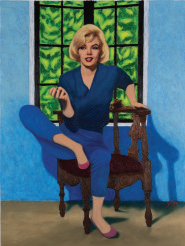
Marilyn (2025)
Triptych 3
Each Panel 36" x 48"
Acrylic on canvas
© James Francis Gill & Premium Modern Art


Artist's Statement
Throughout my life, I have approached the subject of Monroe from a sublime perspective, a mixture of fascination and humility. When I arrived in Los Angeles, the city was in shock after Marilyn’s death. The LIFE magazine dated August 3 was on the table in my studio. I saw the pictures of her published in it and used them as my inspiration for this triptych. I painted it in about three days.
The triptych tells, from left to right, the complete life story of Marilyn, with all its tragedy, in a very simple way, yet complex and with depth. I did not use her nudity in the triptych in an erotic sense; rather, it provides an insight into her deepest psyche. Right down to the open, light-flooded door—Marilyn’s final destination. The third panel is the only image in my entire life’s work that shows Marilyn nude. With this depiction, I wanted to show her vulnerability instead of putting her on display sexually.
In Marilyn Triptych 3 (2025), I returned to Allan Grant’s intimate photo session at Marilyn’s home. The bright windows behind her, flooded with green, allude to the private garden in Brentwood, Monroe’s personal refuge where she sought relief from the pressures of Hollywood. In contrast to the vivid reds of Marilyn Triptych 1, which expressed drama, passion, and pain, the blue here conveys composure and reflection. Monroe herself spoke in interviews about her loneliness and how she felt most at peace by the ocean—a place she associated deeply with the color blue. The clear, radiant lighting recalls the California sunlight that Grant captured at the time—a symbol of one final blossoming. The tragic undertone has given way to quiet intimacy—this is no longer the fallen icon, but the woman who, in her own home, was for a moment truly herself.